


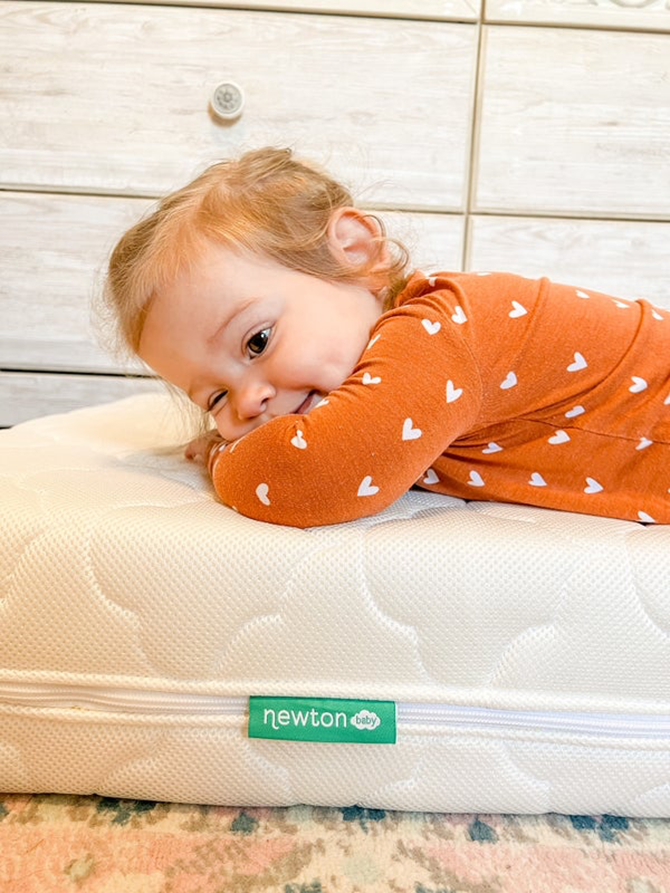
You've heard about floor beds. Maybe you've spotted a gorgeous Montessori nursery on social media, or your toddler has started scaling the crib rail in a very real, terrifying way. Either way, you're wondering: is a floor bed actually the right move, and when is the right time?
The transition out of the crib is one of the bigger sleep shifts you'll navigate in your child’s early years. A floor bed is a legitimate, well-loved option, especially in Montessori-inspired homes. Timing and setup both matter — and if you get it right, it can be a genuinely smooth change. In this article, we'll walk you through everything you need to know.
Key Takeaways
What is a toddler floor bed?
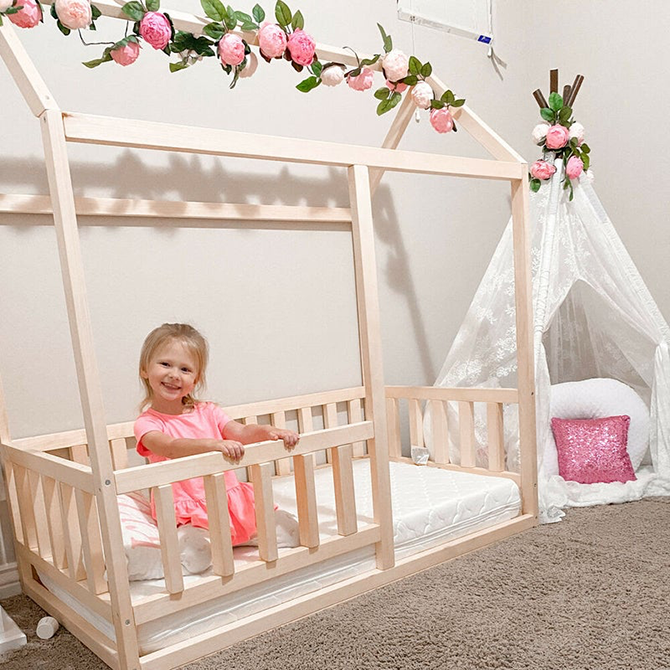
A toddler floor bed is a mattress that rests directly on the floor or on a very low frame — typically just a few inches of clearance. This design keeps everything close to the ground, which means easier access for your child and a much smaller fall risk than a standard toddler bed.
Floor beds come in a few styles:
- Mattress on the floor — the simplest setup; a crib or twin mattress placed directly on the ground
- Low platform frame — a few inches of elevation, similar to a toddler bed but much closer to the floor
- House-style frame — a low frame with a decorative roof structure; popular in Montessori nurseries
The Montessori connection
Floor beds have roots in the Montessori philosophy of early childhood development: an approach built around the idea that children learn best when they have freedom of movement and the ability to explore their environment independently.
In a Montessori-inspired bedroom, the floor bed is the centerpiece: it gives your child full access to their space from the moment they wake up. Rather than waiting to be lifted out of a crib, a toddler on a floor bed can move to their books, their toys or their play area on their own terms.
Montessori floor beds are typically introduced in a room that's been set up intentionally, with low shelves, accessible toys, and uncluttered surfaces. The idea is that independence and safety go hand in hand — the room is designed so that exploring it is always a safe option.
That said, you don't need to follow the full Montessori method to benefit from a floor bed. Plenty of families choose them for their many practical advantages.

Pros of a toddler floor bed
Promotes independence
In a crib, your child depends on you to get in and out, but a floor bed puts them in charge. They can climb in when they're tired, get out when they wake up and access their books and toys without waiting for you — which builds confidence, self-esteem and a healthy sense of autonomy.
Encourages movement
More freedom to move means more opportunity to develop gross motor skills. Your child isn't confined to a small space, letting them stretch, shift positions and move around the room in ways a crib doesn't allow.
Works well in a small room
The low profile of a floor bed eliminates the visual bulk of a crib and frees up space in a smaller nursery.
Minimizes fall risk
Once a toddler can climb out of a crib — which is a clear signal it's time to make a change — a traditional toddler bed still puts them several inches off the ground. A floor bed significantly reduces fall height and related fall risk, due to how close it is to the ground.
Lets you get in there with them
No contorting over crib rails to reach a scared toddler at 2am. You can lie down next to your child easily, which helps during the transition period and any sleep regressions that follow.
Cons of a toddler floor bed
Less contained freedom requires more preparation
The same independence that makes floor beds appealing also means your child has access to everything in the room at night. If their space isn't thoroughly baby-proofed, that's a real safety concern. We know it may sound overwhelming, but it's actually not hard to get right with a little prep.
Allergen exposure
Sleeping closer to the floor means sleeping closer to dust and debris, which can aggravate allergies or asthma. A washable, hypoallergenic mattress matters more here than it does in a raised bed. Look for one that's GREENGUARD Gold Certified and fully washable.
No under-bed storage
On a practical note, with floor beds you lose the storage space that a raised toddler bed provides. If the room is small, that's worth factoring in.
Sleep location surprises
Your toddler may wander off their mattress and fall asleep somewhere else in the room — surrounded by stuffed animals, leaning against a shelf. It's a rite of passage, but it can mean poor sleep quality and an overtired morning.

When to move your child to a floor bed
This is where parents often have the most questions — and where specific guidance matters.
The earliest: 12 months
Some Montessori practitioners introduce floor beds from birth. For safety reasons, we recommend waiting until at least 12 months. Before that milestone:
- Babies shouldn't sleep with loose blankets or pillows, which can create added risk throughout the night
- The room needs to be fully baby-proofed, which takes more work when your child has full floor-level access
At 12 months, some children may be ready for more independence — but readiness and room safety matter.
The typical window: 18 months to 3 years
Most families make the switch somewhere between 18 months and three years. Here are the readiness signs to watch for — these matter more than a specific birthday:
- They're climbing out of the crib. This is the clearest signal. Once they can get out on their own, the crib is no longer safe.
- They have the motor skills to get in and out independently. They should be able to move on and off the mattress without help.
- They understand basic bedtime expectations. "Stay in the room" is a concept they can grasp.
- They're showing interest in more independence. Wanting to do things themselves, resisting being carried, showing curiosity about their space.
The practical milestone: crib-climbing
If your toddler is scaling the crib rail, don't wait for the perfect age — that's your signal to make the move. A floor bed is almost always the safer option once crib containment is no longer reliable.
Age-by-age quick reference
| Age | Floor bed? | Notes |
|---|---|---|
| Under 12 months | Not recommended | Sleep sack entrapment risk; room safety requirements higher |
| 12–18 months | Possible | Proceed only if room is fully baby-proofed and child has strong motor skills |
| 18 months–3 years | Most common transition window | Watch for readiness signs above |
| 3+ years | Still a great option | Many kids use floor beds well into their preschool years |

How to transition from a crib to a floor bed
Start with naps
Before committing to an overnight switch, try it during the day. Remove the mattress from your little one’s crib and place it on the floor for nap time. You'll quickly learn whether the room needs more baby-proofing and how your child responds to the new setup — without the added exhaustion of a nighttime experiment.
Set up the room first
Before the mattress goes on the floor, the room needs to be ready:
- Anchor all furniture to the wall
- Cover outlets and remove cords from reach
- Clear any small toys or choking hazards
- Add a safety gate or childproof doorknob cover that still allows quick adult access in an emergency
- Position the mattress so there are no gaps where your child could become trapped
Get down on your hands and knees and look at the room from their level. Anything within reach should be safe to touch.
Create an inviting space
Let your toddler help pick out their bedding, and put their favorite stuffed animals and a few board books nearby. Spend time together in their new bed before the first night reading a book or playing a simple game. You want the space to feel exciting and familiar, not new and unsettling.
Communicate before you switch
Don't just make the change without a heads up. Talk to your child about what's happening. Use an excited voice. Tell them their new bed means they're getting bigger. Explain what they're allowed to do when they wake up — and what's not okay at nighttime.
They may not absorb every word, but the conversation helps prepare them for what's coming.
Set clear, consistent expectations
Bedtime expectations need to be explicit and repeated:
- They can get off the bed and play quietly in their room
- They can't leave the room or make a lot of noise
- When they wake up in the morning, they can play until you come get them (or a certain light turns on)
Be patient and consistent for the first week. They'll adjust.
Keep a solid bedtime routine
A consistent routine signals that sleep is coming, no matter what kind of bed they're sleeping in. It doesn't need to be complicated, it just needs to happen in the same order every night. Here’s a routine we suggest, but of course you should find the routine that works for you.
- Screens off
- Bath, pajamas
- Brush teeth
- One book in bed
- Hugs and lights out
Prepare for a sleep regression
A regression after a big sleep transition is normal. If it happens, you'll likely see: refusing to go to bed, more fussiness during the day, waking earlier than usual or trouble falling asleep.
Stay calm, keep the routine consistent and give it a few days. If sleep doesn't stabilize after a week or two, talk to your pediatrician.
What to look for in a toddler floor bed mattress
The mattress matters more on a floor bed than it does in a raised frame — your child is sleeping closer to the floor, which means allergen exposure is a real consideration, and breathability and washability move up the priority list.
Breathability
Airflow through the mattress surface reduces the risk of overheating and suffocation. Look for a mattress where breathability is built into the core — not just the cover.
Our Newton Baby Kids' Mattress is built on our patented Wovenaire® technology — 90% air and 10% food-grade material, with no foam, glue, latex or springs. Air moves freely through it in every direction, even if your child’s face is against the surface.
Washability
Floor-level sleeping means more dust exposure. A mattress that's washable from cover to core — not just a removable zip cover — makes a real difference. Our crib and kids' mattresses are fully washable: cover, core and all.
Certifications that mean something
GREENGUARD Gold Certified means the mattress has been independently tested for low chemical emissions and meets the highest indoor air quality standards in the industry. For a child sleeping close to the floor, this matters.
Firmness
For children under two, a firm mattress is still the safer option. Our Newton Baby Original Crib Mattress and Essential Crib Mattress are firm and supportive for younger toddlers. For older toddlers transitioning to a bigger sleep surface, our Kids' Twin Mattress offers the same Wovenaire® core in a twin size — designed for the next few years of sleep.
Fit
Whichever mattress you choose, make sure it fits the frame snugly with no gaps. Entrapment risk at the edges is the same concern as in a crib.
Safe sleep on a toddler floor bed
For babies under 12 months, follow AAP safe sleep guidelines. For toddlers, many of the same safety basics still matter.
- Use a firm, flat mattress
- Keep the sleep surface free from pillows, loose blankets and stuffed animals for children under one year
- Maintain a room temperature of 68–72°F — the range where babies and toddlers sleep most comfortably
- Keep the mattress away from the wall to prevent entrapment
Additional steps that matter specifically for floor beds:
- Baby-proof the entire room — furniture anchored, outlets covered, cords out of reach, small objects removed
- Add a door gate or child-proof lock — so late-night wandering stays in the room
- Use a video monitor — so you can see what's happening and redirect your child without getting up every time
- Pull the mattress from the wall — a few inches of clearance prevents a child from rolling into a gap
FAQ
What age should a toddler start using a floor bed?
Most families make the transition between 18 months and three years. The earliest we recommend is 12 months. The most reliable signal isn't age — it's readiness: your child is climbing out of the crib, has the motor skills to get in and out independently and can understand basic bedtime expectations.
Is a floor bed safe for a toddler?
Yes — when the room is properly set up. The mattress should be firm, away from the wall and free from gaps. The room needs to be fully baby-proofed: furniture anchored, outlets covered, no small toys or cords within reach and a door lock or gate to keep your child from wandering out at night.
What's the Montessori reason for a floor bed?
In Montessori philosophy, floor beds give children freedom of movement and independence from an early age. The idea is that children develop confidence and autonomy when they can get in and out of bed — and access their environment — on their own terms. A floor bed is the starting point for a Montessori-style bedroom designed around safe, independent exploration.
Can I use a crib mattress for a floor bed?
Yes. A crib-sized mattress works for younger toddlers. For children who are ready for more space, a twin-sized mattress on the floor is a natural next step and one they won't outgrow quickly. Our Newton Baby Kids' Twin Mattress is built on the same Wovenaire® core as our crib mattresses — breathable, washable and GREENGUARD Gold Certified.
How do I stop my toddler from wandering at night on a floor bed?
Baby-proof the room thoroughly and add a door gate or child-proof lock. Set clear expectations before the first night and be consistent. A video monitor helps you see what's happening and redirect your child without going in. Most toddlers adjust within a week or two.
What's the difference between a floor bed and a toddler bed?
A toddler bed is a small raised bed — usually around 20 inches off the ground — with short guard rails. A floor bed is at ground level or just above it. The key advantages of a floor bed are the lower fall risk and the independence it gives children who can get in and out on their own.
A toddler floor bed can be a genuinely great move — for the right child, in the right room, at the right time. Watch for the readiness signs, set up the space carefully and give yourself a week or two for the new routine to stick. When you're ready to choose a mattress, look for one that's breathable, washable and built to last through the toddler years and beyond. Sweet, safe dreams.


